



Picture it: It’s a snowy, crisp 28-degree morning in January at Boston Logan International Airport. Months of preparation and planning by the Rex Lumber team has led up to this day. Obtaining business visas, letters of invitation from mills, and coordinating logistics across two countries is no small task. Ahead of the team, a flight to Paris Charles De Gaulle. From there, they’ll fly another 11 hours south to Brazzaville Maya-Maya in the Republic of Congo, the first stop on a two-week sourcing trip across Africa.
Rex Lumber regularly travels to sawmill operations in foreign countries where it sources lumber and other wood products. Maintaining long-standing partnerships, conducting routine legal due diligence, and evaluating emerging species and products firsthand are key to how Rex ensures the integrity of its supply chain. This trip spanned two weeks, splitting time roughly evenly between Congo and Ghana.
Where Does Your Lumber Come From?
 It’s a simple question, but in tropical hardwood markets, the answer isn’t always easy to verify from a desk. The supply chain between a standing tree in Africa and a delivered container at a U.S. port involves multiple stages: harvesting, milling, grading, drying, documentation, and shipping, each with its own standards, regulations, and potential points of failure. The only way to truly verify what’s happening at every stage is to be there.
Rex Lumber has been making these trips for decades. The company’s sourcing relationships in Africa span some of the largest and most established forestry operations on the continent, as well as smaller, developing mills that Rex has worked with over time.
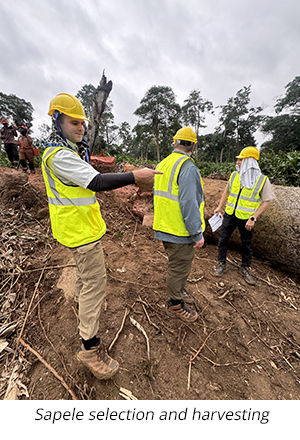
When the Rex team arrives at a mill, the evaluation follows a structured due diligence process developed over years of international sourcing. Rex reviews concession maps, harvesting permits, export documentation, and the systems mills use to track logs from the forest to the mill floor. The team assesses compliance with labor laws, reviews FSC and other third-party certifications where applicable, and evaluates whether there is any risk of illegal harvesting in the concession or the broader region. Each audit concludes with a formal risk assessment that determines whether Rex will do business with that mill.
 That due diligence doesn’t end at the mill gate. On the import side, Rex verifies CITES documentation, country of origin and country of harvest records, Lacey Act declarations, phytosanitary certificates, and bills of lading for every inbound container. By the time a board reaches a Rex Lumber yard, its origin has been verified at every stage of the chain.
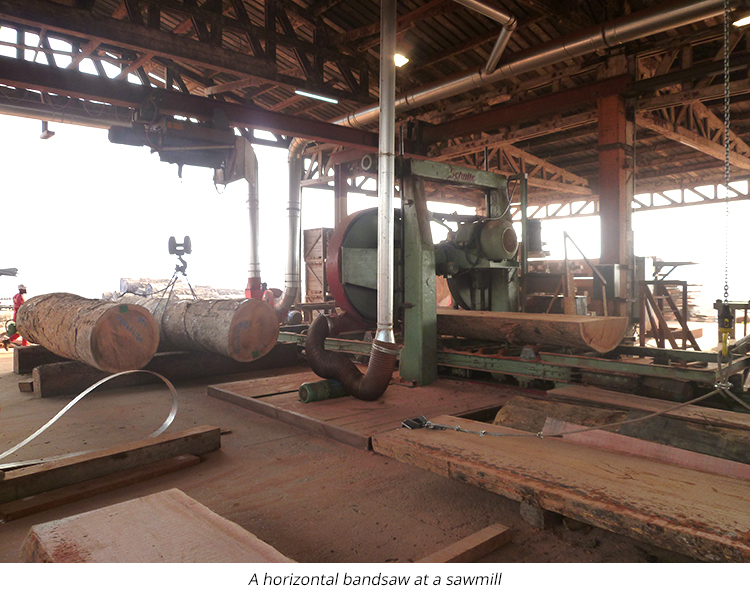
Beyond the paperwork, there are things that only show up in person. Grade consistency, sawing accuracy, drying practices, equipment condition, and how a mill interacts with the surrounding community all tell Rex whether an operation is running optimally. On this trip, the team visited six mills across the Republic of Congo and Ghana. Some were among the most heavily certified forestry operations on the African continent. Others were smaller, developing operations that Rex has worked with over time to help meet its standards.
Legality, Sustainability, and Why They Matter
The global tropical hardwood trade has well-documented challenges with illegal logging and unverified supply chains. Rex Lumber’s position on this is straightforward: there is no gray area. The company only works with mills that are operating legally, harvesting responsibly, and able to demonstrate both through documentation and on-the-ground practices.
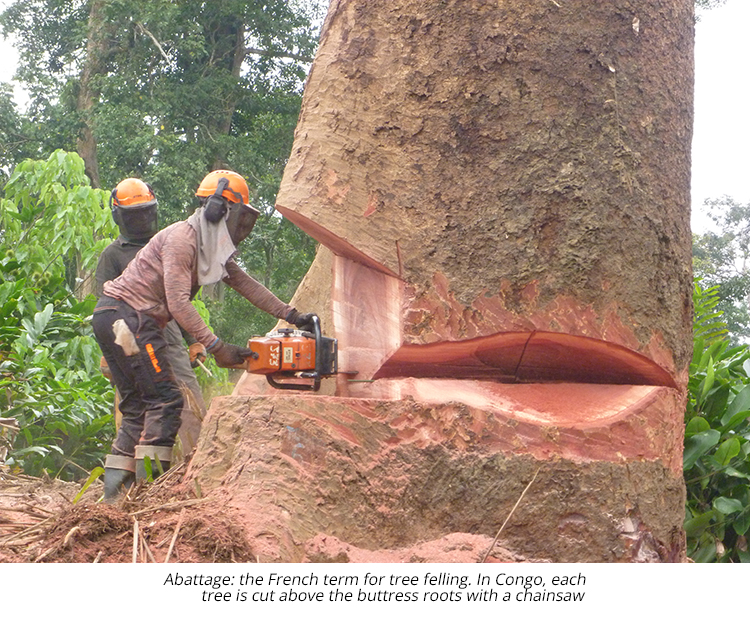
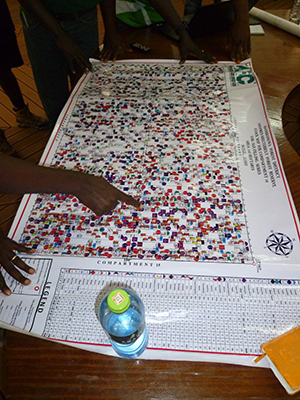 In the Republic of Congo, where Rex spent the first week of this trip, the regulatory environment around forestry is among the most advanced in Central Africa. In 2020, Congo passed forestry legislation making it the only country in the region to require independent certification as a legal obligation. The mills Rex visited in Congo operate FSC-certified concessions spanning hundreds of thousands of hectares, with formal management plans that govern which areas can be harvested, which are set aside for conservation, and which are designated for community development. Harvesting rates are remarkably conservative – less than one tree per hectare, with 30-year rotation cycles that allow the forest to regenerate between cuts.
In Ghana, the picture is different but no less rigorous in terms of what Rex requires. Ghana has become one of the first countries in the world to issue FLEGT licenses – a system developed in partnership with the European Union to verify that exported timber has been legally harvested. Several of the mills Rex visited hold FSC Controlled Wood and Chain of Custody certifications. Others are earlier in that process but operate under valid Timber Utilization Contracts and comply with Ghana’s national forestry regulations. Regardless of where a mill sits on the certification spectrum, Rex applies the same due diligence standards across the board.
What does responsible forestry actually look like on the ground? On this trip, the Rex team walked through concessions where every tree is geolocated and mapped by species before any cutting takes place. They saw operations that monitor forest change through satellite imagery in near real-time. The team visited mills that set aside significant portions of their concessions – in some cases more than a quarter of total land area – exclusively for biodiversity conservation. And they saw firsthand the role these operations play in the communities around them. In parts of the Republic of Congo, the mills Rex works with are among the largest employers in the region, providing not just jobs but healthcare, education, infrastructure, and food security to thousands of people across dozens of villages. At one stop, the team learned that simply mentioning the mill’s name at an airport 15 hours away drew immediate recognition – that is the scale of impact these operations have.
What Rex Is Sourcing, and Why It Matters
African hardwoods have long been valued for their durability, workability, and aesthetic range. For architects, builders, and manufacturers, they offer options that domestic species often cannot – wider and longer dimensions, natural resistance to decay and insects, and a depth of color and figure that performs well across high-end millwork, flooring, exterior cladding, decking, furniture, and marine applications.
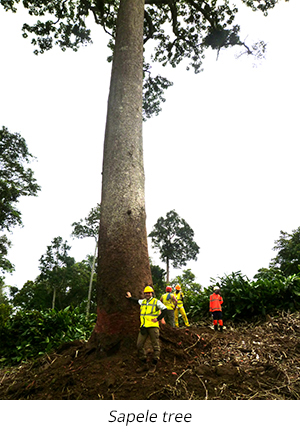
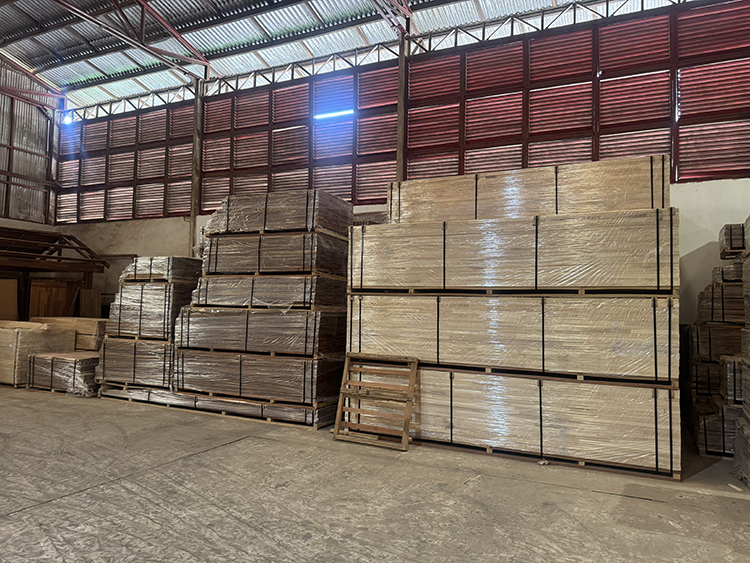
Rex Lumber offers a broad range of African species, including African Mahogany (Khaya), Sapele, Utile, Iroko, Wenge, Afromosia, and Aniegre. Of these, African Mahogany and Sapele are the highest-volume species in Rex’s stock inventory, and are featured across the company’s moulding, S4S, flooring, and custom stocking programs.
African Mahogany
African Mahogany has long been valued by millwork shops, cabinetmakers, and manufacturers for one simple reason: It works as beautifully as it looks.
Sourced from West and parts of Central Africa, African Mahogany delivers the classic character of traditional mahogany; a warm reddish-brown tone and consistent grain pattern, and dependable performance.
It cuts cleanly, machines smoothly, and accepts a wide range of finishes, making it a reliable choice for precision millwork and architectural applications. Because of its stability and workability, it’s commonly used for:
- Architectural millwork
- Interior mouldings and trim
- Cabinetry and furniture
- Paneling and door components
- Specialty fabrication projects
Sapele
Sapele is renowned for having the warmth of mahogany with added durability and striking visual character.
Native to tropical regions of West and Central Africa, Sapele boasts a rich reddish-brown color and distinctive grain, which can produce beautiful ribbon, stripe, or fiddleback patterns when quarter-sawn.
Sapele machines well, finishes smoothly, and develops a deep, polished look. The result is a hardwood that offers both structural performance and visual depth, making it a favorite among millwork shops and manufacturers. Because of its strength, stability, and valued appearance, Sapele is commonly specified for:
- Architectural millwork
- High-end cabinetry and furniture
- Doors, panels, and mouldings
- Musical instruments
- Specialty woodworking and interior applications
Rex Lumber helps its customers bring their projects to life with materials like African Mahogany and Sapele that add warmth, durability, and distinctive character to their projects, and perform as well in the shop as they do in the finished space.
Evaluating and Exploring
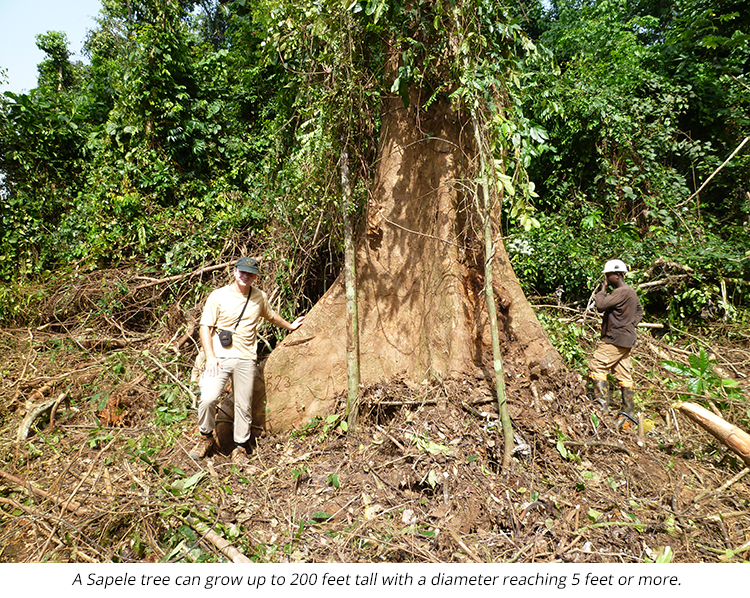
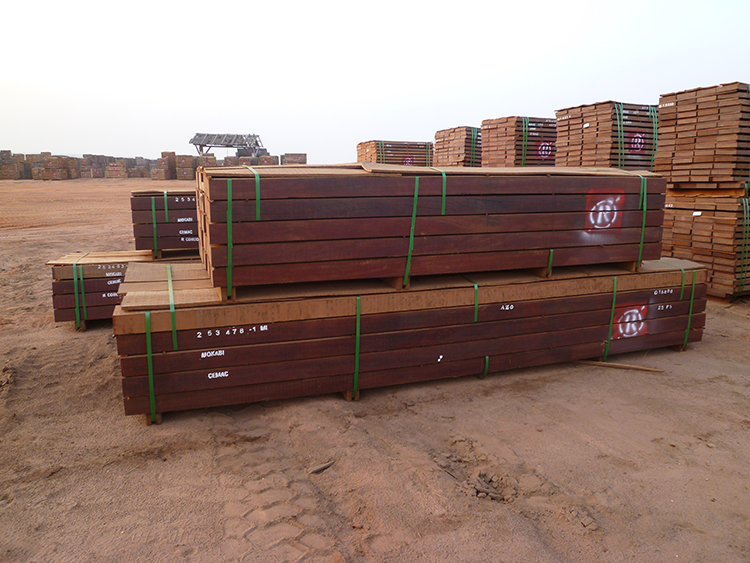
On this trip, the team was primarily evaluating Sapele and Utile from the Republic of Congo, and African Mahogany (Khaya) and Spanish Cedar (Cedrela) from Ghana. Each species has a different sourcing profile. Sapele and Utile come from large, established concessions in the Congo Basin where supply is consistent and certification infrastructure is well developed. African Mahogany is sourced from several mills across Ghana’s Western and Ashanti regions, where Rex has maintained purchasing relationships for years. Cedrela is a plantation-grown species harvested in Ghana’s Central Region – a different model from natural forest concessions, and one that Rex is evaluating as demand for sustainably planted alternatives continues to grow.
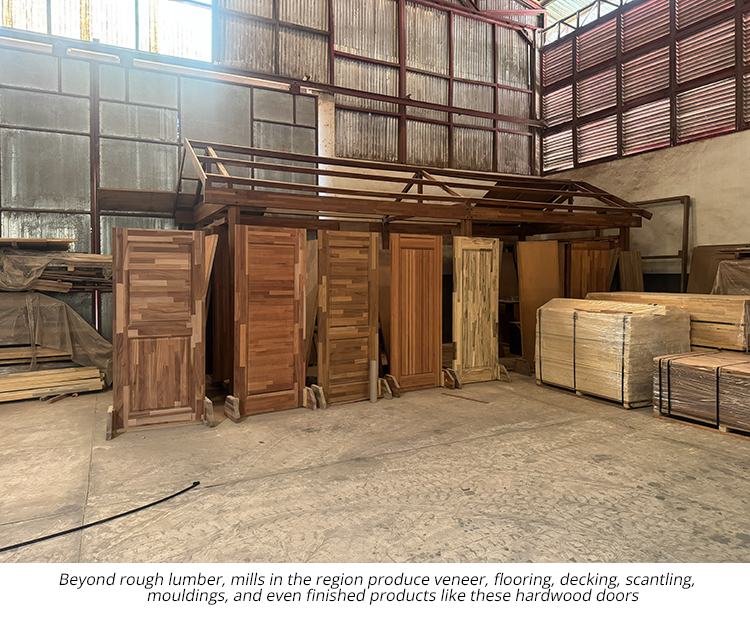
And several of the mills visited – particularly the larger, more diversified operations – demonstrated capabilities beyond sawn lumber, including veneer, plywood, finger joint, glued laminated panels, and cut-to-length blanks. These value-added capabilities are increasingly relevant to Rex’s customers who are looking for more finished or semi-finished products sourced directly from origin.
Rex’s ability to source directly – rather than through intermediaries – means the company has more control over species selection, grade consistency, dimensions, and preparation. When Rex’s buyers are standing in the mill evaluating lumber firsthand, they can match what they’re seeing to what their customers actually need. That connection between the source and the end user is difficult to replicate any other way.
What This Means for Rex Lumber Customers
When Rex Lumber invests the time and resources to visit mills in person, the benefits flow directly to the customers who rely on the company for their tropical hardwood supply.
Verified quality means that Rex has physically inspected the operation producing the material, not just reviewed a spec sheet or accepted a grade stamp at face value. The team has walked the mill floor, evaluated the lumber, and assessed whether the operation meets Rex’s standards for grading, drying, and sawing accuracy.
Legal certainty means that every container Rex imports has been verified through a documented chain of custody – from concession to port. Lacey Act declarations, CITES documentation where applicable, phytosanitary certificates, country of origin records, and export permits are reviewed and filed for every shipment. Customers can specify Rex’s tropical hardwoods with confidence that the material was legally harvested and properly documented.
Reliable supply means that Rex isn’t sourcing opportunistically. Long-term contracts and multi-year relationships with established mills give Rex consistent access to inventory, even when markets tighten. When a customer needs a specific species in a specific dimension on a specific timeline, Rex’s direct relationships make that possible in ways that buying through intermediaries cannot.
And expertise means that Rex’s team – including a buyer who also serves as president of the industry’s leading international trade association – understands the species, the regions, the regulatory landscape, and the mills themselves. That depth of knowledge translates into better recommendations, more accurate lead times, and fewer surprises on the receiving end.
For architects, builders, and manufacturers who are specifying tropical hardwoods, the question worth asking any supplier is simple: How do you know where this lumber came from? Rex Lumber can answer that question in detail – because the company was there.